
Domain 4 — Perform evaluation, error analysis, and tuning — is 15–20% of the exam. This is where strong everyday developers most often leak points, because daily coding rarely forces you to formally evaluate an agent, taxonomize its failures, and tune it deliberately. Slow down here.
The exact skills measured in Domain 4:
- Define success criteria and evaluation signals — specify expected outcomes and operational constraints; identify qualitative and quantitative signals; align criteria with development intent; generate signals using automated scanning tools.
- Analyze agent failures and identify root causes — use logs, plans, traces, outputs, and workflow artifacts; classify root causes (reasoning errors, tool misuse, context/environment issues).
- Tune agent behavior based on results — revise instructions, workflows, or constraints; refine memory usage; refine tool usage and access.
Defining success criteria and evaluation signals
You cannot evaluate what you did not define. Domain 4 starts where Domain 1 ended: a pre-stated, measurable success criterion.
Two kinds of signal, and you need both:
| Signal type | Examples | Reads on |
|---|---|---|
| Quantitative | Tests pass/fail, scan findings count, coverage delta, build status, latency | Did it objectively work? |
| Qualitative | Code readability, did it follow conventions, is the approach sound | Did it work well? |
Align criteria with development intent. The agent should be judged against what the team actually wanted — not a proxy it can game. “Tests pass” is gameable (edit the test); “fixes the root cause without weakening tests” is aligned with intent.
Generate signals with automated scanning tools. This is GitHub-flavored: code scanning, secret scanning, dependency review, CI results. These produce objective evaluation signals automatically on every agent PR — exactly the artifacts Domain 4 wants you to use.
Scenario — aligned vs. gameable criteria. Goal: “resolve the security finding.” Gameable signal: “the scanner no longer flags line 42” — an agent could suppress the rule. Aligned signal: “the vulnerable pattern is removed, no new findings introduced, tests still pass.” Write criteria the agent cannot satisfy by cheating.
Root-cause analysis of failures
When an agent fails, Domain 4 wants a disciplined diagnosis using the evidence GitHub already captures.
The evidence sources (memorize this list — it’s lifted from the skills measured):
- Logs — what happened, step by step (Actions/session logs).
- Plans — what the agent intended (recall structured plans from Domain 1).
- Traces — the sequence of tool calls and decisions.
- Outputs — the diff, the PR, the result.
- Workflow artifacts — CI results, scan reports.
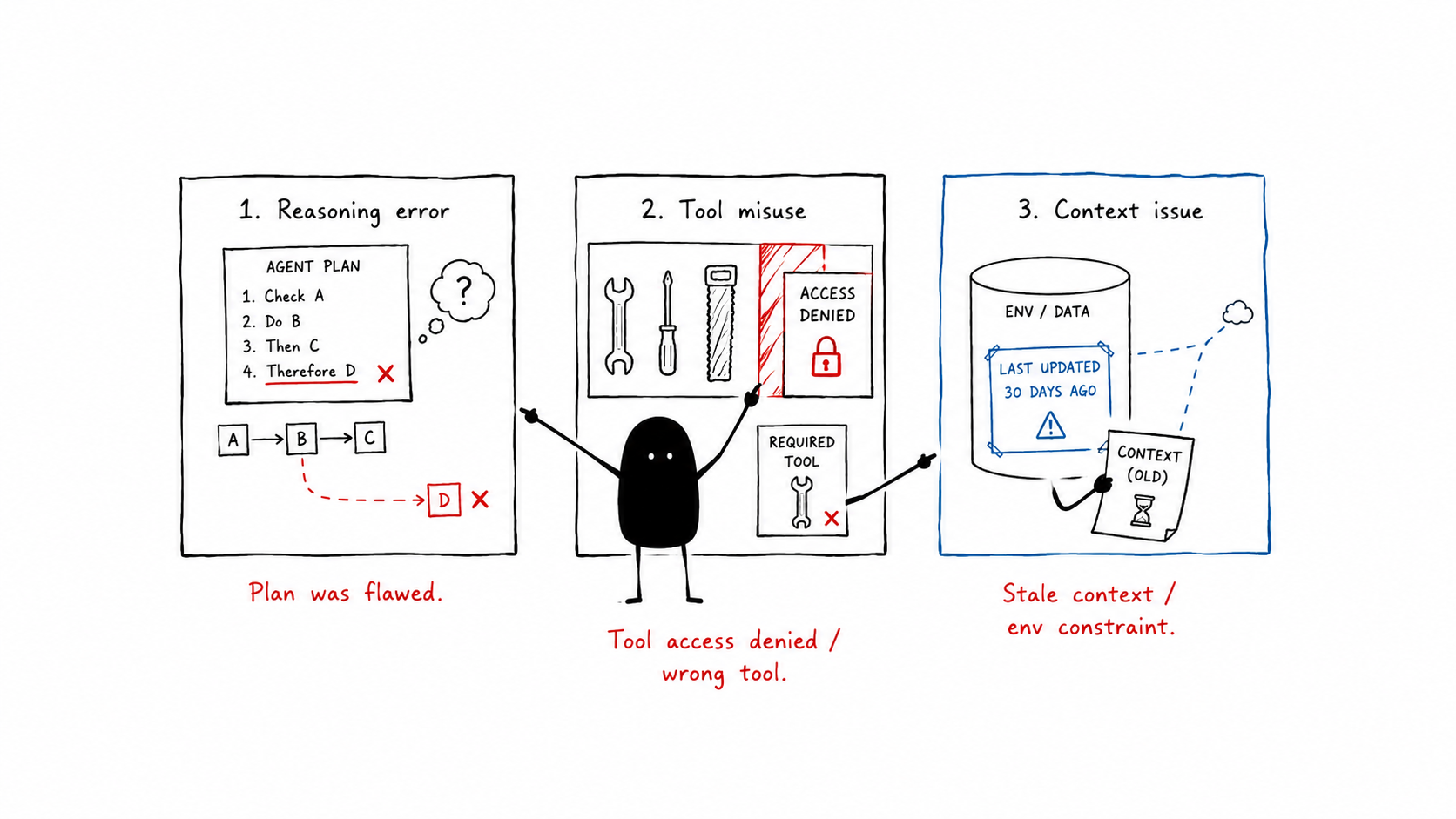
The root-cause taxonomy (also straight from the objectives — expect to classify a failure into one):
| Root-cause class | What it looks like | Typical fix (→ tuning) |
|---|---|---|
| Reasoning error | Flawed plan, wrong logic, bad decomposition | Revise instructions / require validated plans |
| Tool misuse | Wrong tool, wrong inputs, missing permission, ignored a tool | Refine tool usage / access |
| Context or environment issue | Stale/missing context, wrong runtime, env constraint | Refine memory; fix setup/environment |
Scenario — classify the failure. An agent opens a PR that fails to compile because it called an API that doesn’t exist in the project’s library version. Logs show it never read the dependency manifest. Root cause: context/environment (it acted without the env’s actual constraints), arguably with a tool-misuse edge (didn’t use available read tools). Fix: ensure it reads the manifest (memory/context) and/or adjust setup. The exam wants you to name the class, then pick the matching fix.
The diagnostic reflex: start from the output (what went wrong), walk the trace (what it did), check the plan (what it intended), and read the logs (what the environment reported). The gap between plan and trace usually reveals the class.
Tuning based on results
Diagnosis is worthless without the corrective action. Domain 4 names three tuning levers — match the lever to the root cause:
| Lever | Use when | Example |
|---|---|---|
| Revise instructions / workflows / constraints | Reasoning errors, repeated bad patterns | Add “diagnose root cause before editing”; forbid touching test files on bugfix tasks |
| Refine memory usage | Context issues — stale, missing, or bloated context | Add the convention to long-term memory; fetch volatile data fresh |
| Refine tool usage and access | Tool misuse — wrong/missing/over-broad tools | Add the needed tool; remove an unnecessary one; tighten permissions |
Scenario — close the loop. An agent keeps ignoring the team’s error-handling convention (reasoning/instruction gap). You add the convention to custom instructions (revise instructions), confirm it’s in long-term memory (refine memory), and re-run. Next failure is a different class → different lever. Tuning is iterative: diagnose → adjust the matching lever → re-evaluate.
The full evaluation loop
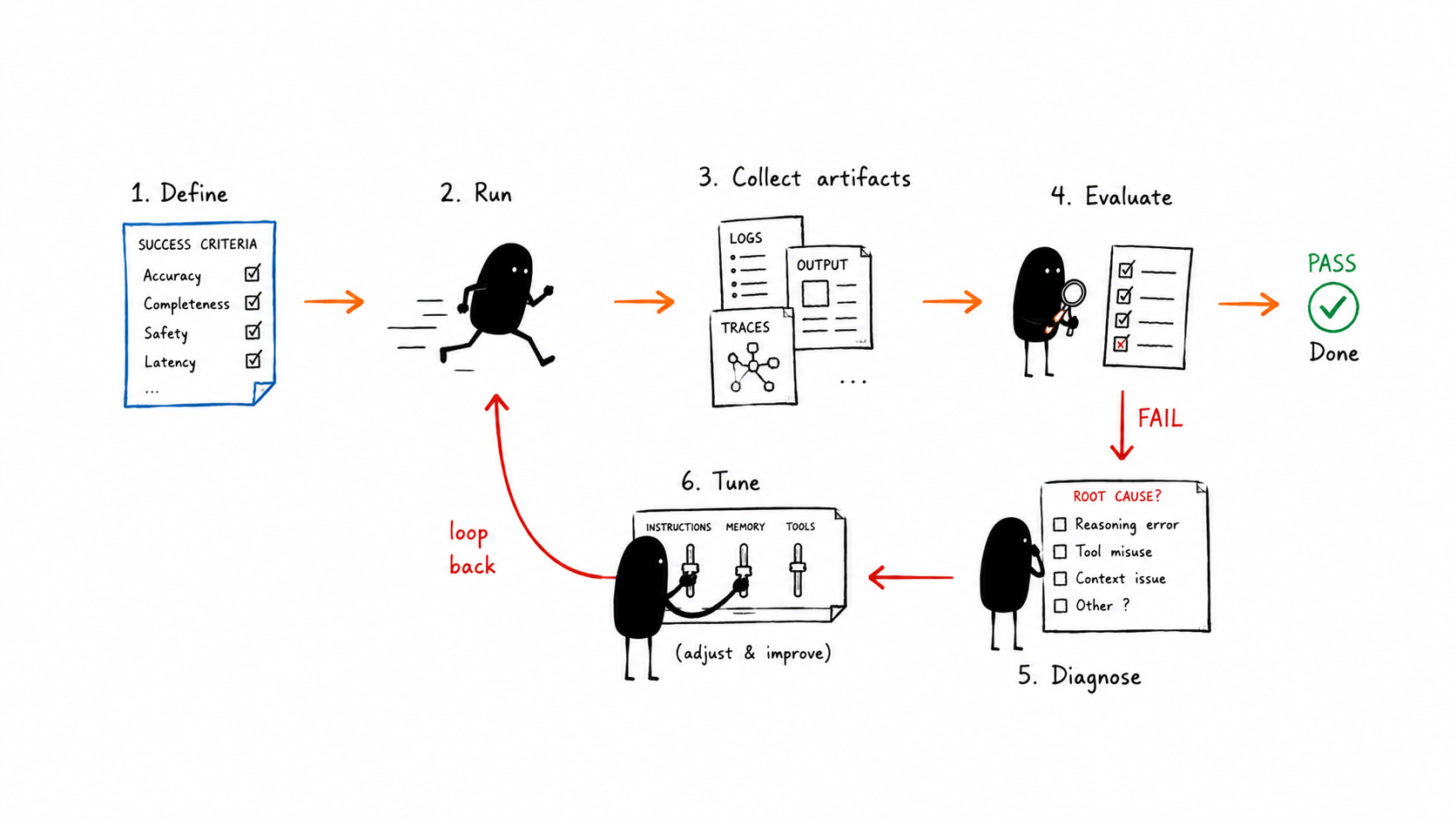
Domains 1, 3, and 4 form one cycle the exam keeps probing:
- Define success criteria + signals up front (Domain 1/4).
- Run the agent, capturing artifacts (Domain 2/3).
- Evaluate against the criteria using quantitative + qualitative + scan signals.
- Diagnose failures → classify the root cause.
- Tune the matching lever (instructions / memory / tools).
- Re-evaluate.
If you can narrate this loop, you can answer most of Domain 4.
Exam-style check
Q1. An agent makes the security scanner stop flagging an issue by suppressing the rule. What went wrong with the evaluation design?
A. The success signal was gameable / misaligned with intent. Define criteria as “vulnerability removed, no new findings, tests pass” — not “scanner no longer flags it.”
Q2. An agent’s PR fails because it used a function from a library version the repo doesn’t have. Which root-cause class?
A. Context/environment issue — it acted without the environment’s real constraints. Fix by ensuring it reads the manifest (memory/context) and correct setup.
Q3. Which evidence best reveals what the agent intended vs. what it actually did?
A. Compare the plan (intended) against the trace (actual tool calls/decisions). The divergence localizes the failure.
Q4. An agent repeatedly chooses the wrong tool for a task. Which tuning lever?
A. Refine tool usage and access — adjust which tools it has and how it’s instructed to use them.
Q5. Name two automated sources of quantitative evaluation signal on a GitHub agent PR.
A. CI test results and code/secret/dependency scanning findings (also build status, coverage delta).
What to memorize
- Pre-state measurable success criteria; use quantitative + qualitative signals; align with intent so they can’t be gamed; lean on automated scans.
- Diagnose from logs, plans, traces, outputs, workflow artifacts.
- Classify root cause: reasoning error · tool misuse · context/environment issue.
- Tune the matching lever: instructions/workflows · memory · tool usage/access.
- It’s a loop: define → run → evaluate → diagnose → tune → re-evaluate.
Next: Domain 5 — orchestrating multiple agents.