
My job in this path is narrow and honest: get you through Exam GH-600 — Developing in Agentic AI Systems on the first attempt, without filler and without hand-waving. Everything here maps to the official skills measured. Where a detail is a product feature that changes between GitHub releases, I will say so and point you at the source instead of inventing a number.
One framing to carry through every module: GH-600 is not “do you know what an LLM is.” It is “can you operate, supervise, and govern autonomous agents inside a real SDLC, with GitHub as the system of record and control plane.” Every question is really asking: who is accountable, what is the blast radius, and where is the evidence?
What this certification is
| Fact | Detail |
|---|---|
| Credential | GitHub Certified: Agentic AI Developer (beta) |
| Exam code | GH-600 |
| Level | Intermediate |
| Maintained by | GitHub (delivered through Microsoft / Pearson VUE) |
| Duration | 120 minutes |
| Passing score | 700 out of 1000 (scaled — not a raw percentage) |
| Delivery | Proctored, online or test center |
| Languages | English (request +30 min if English is not your first language) |
| Retake | 24 hours after a first failed attempt; longer waits after that |
A note on the beta: during the beta window you do not get your score immediately. Results are released roughly eight weeks after the beta period closes. Plan emotionally for that delay — you will walk out not knowing, and that is normal.
Two links, one exam — clear this up now. The Microsoft Learn page (
learn.microsoft.com/.../agentic-ai-developer/) and the GitHub learning page both describe the same credential. Microsoft delivers the exam; GitHub owns the content. There is no separate “Microsoft Agentic AI Developer” exam hiding behind that URL — it is GH-600.
The six domains and their weight
The exam is built from six domains. The weighting tells you exactly where to spend study time. Memorize this table — it is your triage map.
| # | Domain | Weight | This path’s module |
|---|---|---|---|
| 1 | Prepare agent architecture and SDLC processes | 15–20% | Intermediate · M1 |
| 2 | Implement tool use and environment interaction | 20–25% | Intermediate · M2 |
| 3 | Manage memory, state, and execution | 10–15% | Intermediate · M3 |
| 4 | Perform evaluation, error analysis, and tuning | 15–20% | Advanced · M1 |
| 5 | Orchestrate multi-agent coordination | 15–20% | Advanced · M2 |
| 6 | Implement guardrails and accountability | 10–15% | Advanced · M3 |
Domain 2 is the single heaviest area. Tool use, MCP servers, permissions, and execution environments can be a quarter of your score. If you are short on time, this is where the marginal hour pays best. Domains 3 and 6 are the lightest — do not skip them, but do not over-invest either.
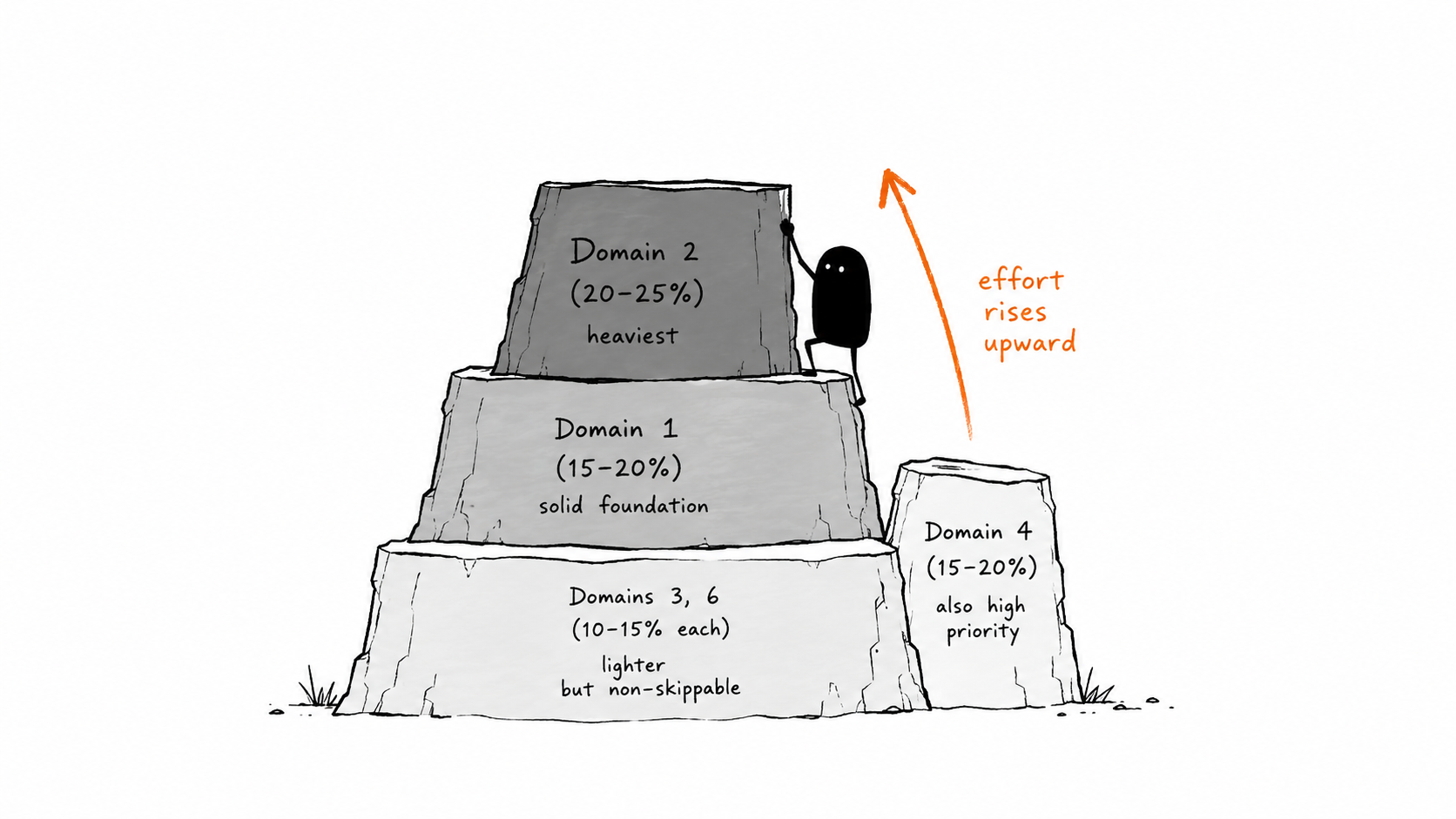
How to read the weightings strategically
A scaled exam with a 700 cut score means you do not need every question. Rough math on a ~50-question exam: you can miss a meaningful slice and still pass, but the margin disappears if you tank an entire heavy domain. So the goal is no zeros — never walk in blind on Domain 2 or 4.
Scenario — where people fail. A strong developer who uses Copilot daily often walks in confident and fails Domain 6 (guardrails) and Domain 4 (evaluation). Why? Day-to-day coding rarely forces you to classify an action by compliance risk or write a root-cause taxonomy for an agent failure. The exam does. The “obvious” domains are not where points leak — the governance and evaluation domains are.
What you need before you start
You should already be comfortable with:
- The software development lifecycle in GitHub: branches, pull requests, reviews, required checks, Actions.
- GitHub Copilot as a coding tool — chat, the coding agent, custom instructions.
- Basic security and code-review hygiene: least privilege, secrets, who can merge what.
If any of those are shaky, the next two beginner modules fix the agentic mental model and the GitHub-as-control-plane model before we go domain by domain.
How this path is structured
- Beginner (3 modules) — the mental model. What “agentic” means inside an SDLC, and how GitHub becomes the control plane (Copilot coding agent, custom agents, MCP).
- Intermediate (3 modules) — Domains 1, 2, 3 in depth, one module each.
- Advanced (4 modules) — Domains 4, 5, 6 in depth, then an exam-day first-attempt playbook with practice questions and a time strategy.
Each domain module follows the same rhythm: the exact sub-skills the exam lists, the concept taught plainly, a worked scenario, the traps that lose points, and exam-style questions with why the answer is right.
Hands-on work is non-negotiable
Reading this path alone will not pass the exam. GH-600 is an applied credential testing whether you can operate agents in a real SDLC, not whether you can define concepts.
Before exam day, you must do all three:
- Assign the GitHub Copilot coding agent a real task in a real repo — configure custom instructions, set it loose on a multi-step issue, review its PR, watch it fail and recover. Feel how it reasons.
- Configure an MCP server (GitHub’s or a community one) as a tool, wire it to an agent, and observe it in action. Know the difference between local and remote.
- Set up a branch ruleset + bypass actor — create a protected branch rule that blocks merges, then explicitly add Copilot as a bypass actor for a specific scenario. Understand why scoping the exception is better than removing the rule.
Do not skip this. A strong engineer who reads this path but skips hands-on will leak points on Domains 2 and 6 where the exam tests judgment, not recall.
Official resources (use these, not memory dumps)
- Study guide:
aka.ms/GH600-StudyGuide— the authoritative skills-measured list. If this path and the study guide ever disagree, the study guide wins. - Exam sandbox:
aka.ms/examdemo— practice the interface and question types before exam day so the UI is never a surprise. - Official training: the Microsoft Learn modules Foundations of Agentic AI in GitHub, Designing Agent Architecture and SDLC Integration, and Tooling, MCP, and Agent Execution Environments.
- Product truth: GitHub Docs for Copilot coding agent and MCP. Product features move; when a question hinges on a current default, the docs are ground truth.
Honesty clause. This is a beta exam built on fast-moving products. I have written every technical claim from the official study guide and GitHub’s own documentation. Where a feature default could change (session limits, which MCP servers are on by default, exact UI labels), I flag it. Treat any specific number as “verify against current docs before exam day.”
Required artifact for this path
By the end, you should be able to do three things from memory:
- Recite the six domains and their weights.
- For any agent action, state its autonomy level, blast radius, and required human checkpoint.
- Trace any agent failure to a root-cause class and name the fix.
If you can do those three, you are ready. Start with the next module: what “agentic AI in the SDLC” actually means.